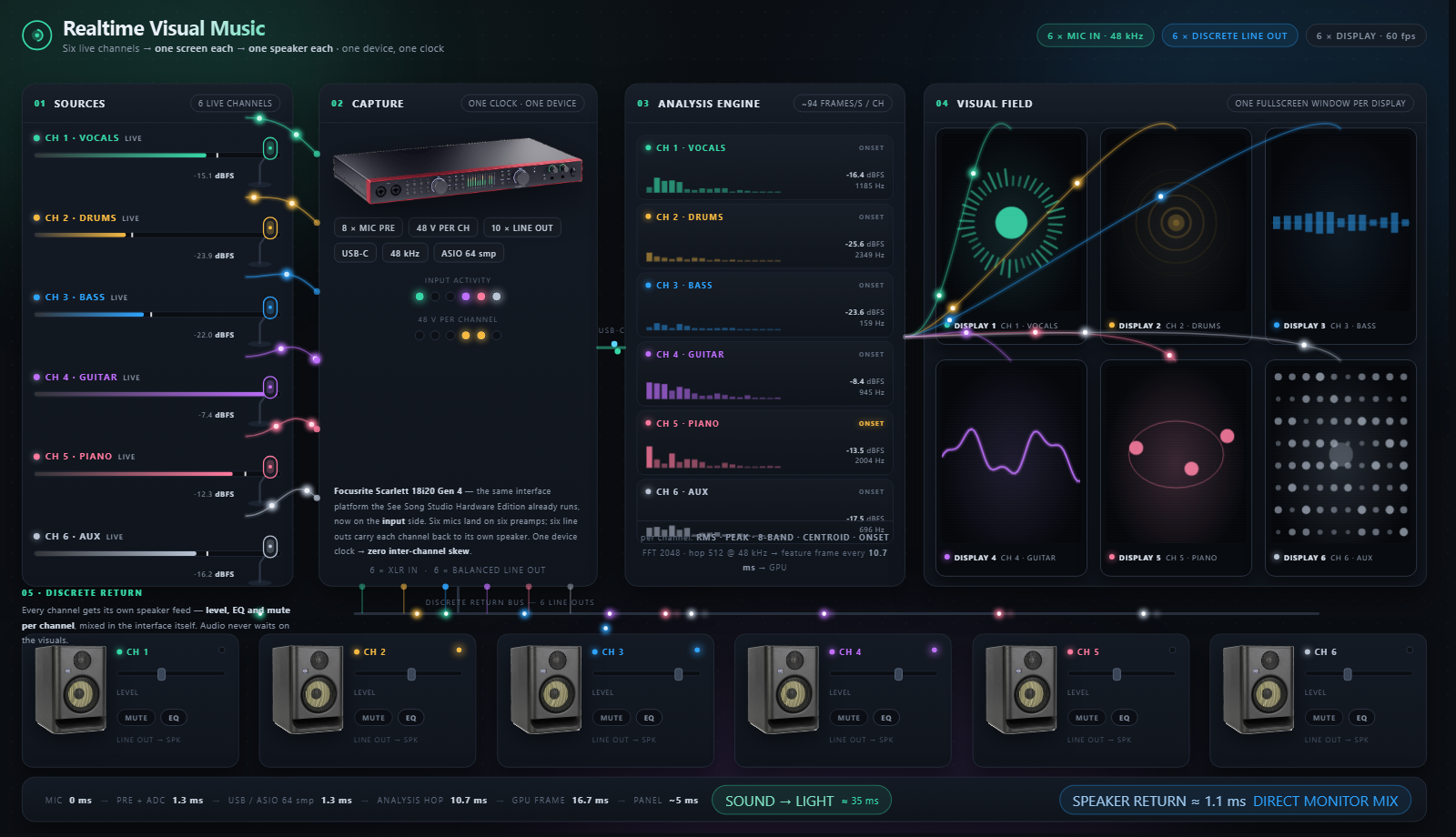
A rig that listens to six live sources at once, reads each one in real time, draws it on its own monitor, and sends it to its own speaker — with level, EQ and mute per channel. This is the hardware that does it, how the pieces connect, and what it measures.
Live animated schematic — mics into preamps, one USB stream to the analysis engine, six feature streams to six fullscreen windows, and six discrete line outs straight back to their own speakers. Everything on this page is drawn from the same build.
Six mic inputs and six discrete outputs, one device clock, one driver — the whole job lands on a single box. Everything else is sources, speakers and screens.
| Pick | Model | Why it wins here |
|---|---|---|
| Interface | Focusrite Scarlett 18i20 Gen 4 | 8 mic pres (48 V + gain per channel), 10 line outs, USB-C, one ASIO stream. Six in and six out with two spare each way — and it is the same platform the See Song Studio Hardware Edition already runs, now on the input side. |
| Budget fit | Behringer XR18 | 16 Midas mic pres and 6 aux outs — the aux sends are literally this job. Internal gate/EQ/comp per channel and per-aux mixes; ~$509. |
| Step up | MOTU 8pre-es | 8 mic in / 8 line out, AVB, onboard DSP mixer, better converters; ~$1k. |
| Bulletproof | RME UFX III + 2-ch preamp | Best drivers and TotalMix FX per-output mixes — but only 4 mic pres on its own, so mics 5–6 need a preamp. |
The audio path and the visual path split at the interface. That split is the whole design: the sound never waits on the computer.
Six mics land on six preamps. A single multichannel ASIO stream at 48 kHz / 64 samples (1.33 ms buffer) carries all six into the host. Everything downstream inherits that one device clock, so there is zero inter-channel skew — no drift between channels, ever.
Per channel: DC block → RMS and peak → FFT 2048 with a 512-sample hop → 8-band energy, spectral centroid and spectral-flux onset. A complete feature frame lands every 10.7 ms — each channel is measured on its own terms, not as part of a mix.
One fullscreen window per monitor, placed by the host, each rendering its own channel at 60 fps from the feature stream. A visual is a pure function of its feature frames — nothing to keep in sync, so there is nothing to drift.
Per-channel speaker feeds are built inside the interface, not in software: one mix per output, each routed to a physical line out. Level, EQ and mute per channel at ≈ 1.1 ms, and the audio keeps playing even if the computer or the visuals hiccup.
48 kHz reference, 64-sample ASIO buffer. Two thirds of the sound-to-light delay is the display pipeline, not the audio.
| Stage | Time | Where it lives |
|---|---|---|
| Preamp + ADC | 1.3 ms | Interface analog in — one conversion, no resampler in the path |
| USB / ASIO, 64 samples | 1.3 ms | Driver period at 48 kHz; bypasses the Windows mixer entirely |
| Analysis hop | 10.7 ms | 512-sample hop, FFT 2048 — the feature frame rate |
| GPU frame | 16.7 ms | One 60 fps frame — the single biggest line item |
| Panel response | ~5 ms | Display glass |
| Sound → light | ≈ 35 ms | ≈ two display frames of total pipeline |
| Speaker return | ≈ 1.1 ms | Interface direct monitor mix — the PC is not in this path at all |
Six of everything on the audio side; the displays are the only place a build has real choice.
The diagram above is not decoration — it was instrumented and measured in a real browser.
Every display flash is computed from the position of its own signal ball, not from a parallel clock. Sampling the ball's path position against the screen's brightness over CDP, the flash peaks within 8 ms of the ball arriving — half a frame at 60 fps — over repeated events.
This page and its assets were fetched back from this server and compared to the local build: served bytes are identical, and the live URL is title-checked so a host's catch-all page can never masquerade as content.
Latency figures are per-stage values at 48 kHz / 64 samples — buffer, hop, frame, panel — not a single round-trip estimate. The speaker return is listed separately because it never enters the computer.